

Laser components sit between optical theory and the equipment that has to work reliably in the field. A laser diode, fiber-coupled source, detector, isolator, coupler or other optical device may have excellent individual specifications, yet still create problems when its wavelength, package, power level, fiber type, thermal conditions or optical interfaces do not match the rest of the system. This guide explains the practical factors engineers and purchasing teams should examine when selecting laser components, with particular attention to integration, stability, optical performance and long-term application requirements.
Why Laser Components Determine System Performance
A laser system is rarely defined by its light source alone. The component surrounding the source determines how effectively optical energy is generated, coupled, transmitted, controlled, detected and delivered to the working point. For this reason, component selection should be treated as part of the optical system design rather than as a simple catalog purchasing exercise.
Engineers may encounter problems such as insufficient optical power, unstable output, excessive back reflection, poor coupling efficiency, thermal drift or unexpected signal loss. These issues are often related not to one isolated specification but to the interaction between several components.
Industry selection guides commonly emphasize parameters such as wavelength, pulse duration, repetition rate, polarization and average or peak power when specifying laser optics and related components.
Which Types of Laser Components Are Commonly Used?
The term laser components covers a wide range of semiconductor and photonic devices. The correct category depends on whether the system needs to generate light, amplify it, couple it into fiber, control the optical path or receive the resulting signal.
| Component Type | Typical Function | Important Selection Factors |
|---|---|---|
| Laser Diodes | Generate laser light directly from a semiconductor device | Wavelength, output power, threshold current, efficiency, package |
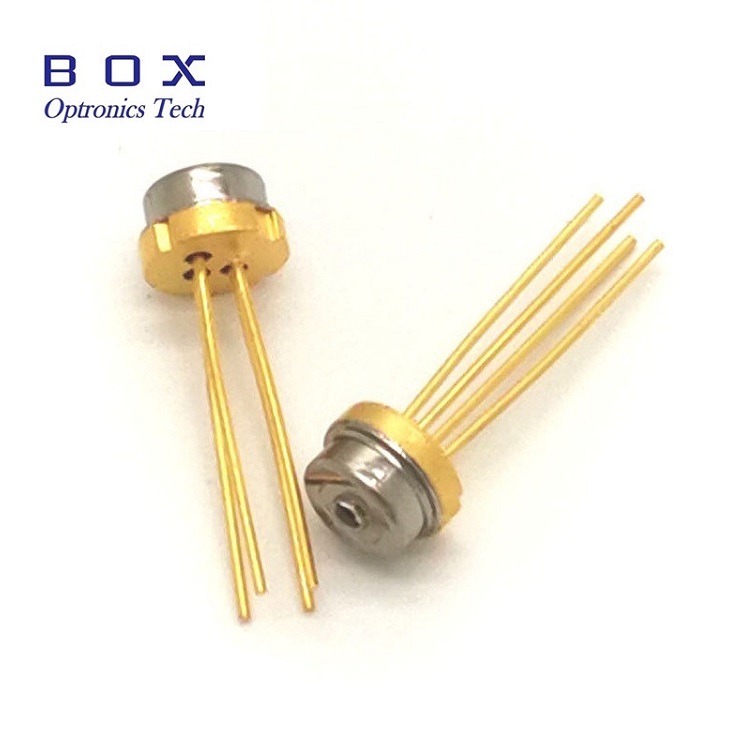
| TO-CAN Laser Diodes | Compact laser source for sensing, communication and instrumentation | Package size, wavelength, power, electrical interface and thermal behavior |
| Chip on Submount / COS | Compact high-power semiconductor laser configuration | Power density, heat dissipation, coupling arrangement and mounting |
| Fiber-Coupled Lasers | Deliver laser output through optical fiber | Fiber type, coupling efficiency, wavelength, output power and connector |
| DFB Laser Diodes | Provide narrow spectral output for communication and sensing | Center wavelength, linewidth, side-mode suppression and stability |
| VCSELs | Provide compact vertical-cavity laser emission | Wavelength, modulation performance, power and package |
| Pump Lasers | Supply optical energy to fiber amplifiers and related systems | Pump wavelength, output power, coupling and reliability |
Modern suppliers may combine semiconductor laser components with fiber modules, photodiodes and passive optical components to provide a more complete optical solution. Box Optronics, for example, lists chip-on-submount laser diodes, TO-CAN laser diodes, fiber-coupled lasers, photodiodes and passive optical components within its product range.
Why Wavelength Comes Before Package Selection
Wavelength is one of the first parameters that should be established because every downstream optical component must be compatible with the intended spectral range. A package can be mechanically convenient while the optical output is completely unsuitable for the application.
For example, telecommunications, fiber sensing, industrial measurement and LiDAR applications may operate in very different wavelength regions. Fiber transmission characteristics, detector sensitivity, optical coating performance and atmospheric absorption can all change with wavelength.
The substrate and coating of an optical component should also be selected according to the required spectral range and operating conditions. Material properties such as refractive index, transmission range, thermal expansion, temperature stability and laser resistance can influence performance.
A useful procurement document should therefore state the required center wavelength or wavelength range instead of simply requesting a generic "laser diode."
How Output Power and Operating Mode Affect Selection
Output power is another major consideration, but the number alone does not tell the complete story. A component operating continuously at a moderate power level can have very different requirements from a pulsed laser producing a high peak power for a short duration.
For continuous-wave applications, engineers should examine continuous output power, efficiency, operating current and thermal behavior. For pulsed systems, pulse width, repetition frequency, peak power and average power become equally important.
| Operating Mode | Parameters to Confirm | Typical Concern |
|---|---|---|
| CW | Continuous output power, current, efficiency, temperature | Long-term thermal stability |
| Quasi-CW | Duty cycle, pulse duration, peak power | Thermal cycling and power stability |
| Pulsed | Peak power, pulse width, repetition rate, average power | Peak optical and electrical loading |
| Modulated | Modulation bandwidth, rise time, drive conditions | Signal integrity and dynamic response |
Selecting a component solely because its advertised output power is higher can therefore be misleading. Excess power may create unnecessary thermal load, while insufficient power can reduce system margin. The target operating point should be matched to the actual application.
Package and Fiber Interface Considerations
Packaging is where optical performance meets mechanical engineering. Two laser components with similar optical specifications may require completely different system designs because their packages, electrical connections, heat paths and fiber interfaces are different.
Common semiconductor laser packages include TO-can formats, butterfly packages, pigtail configurations, chip-on-submount structures and C-mount designs. Box Optronics currently lists 5.6 mm and 9 mm TO-can packages, butterfly packages, pigtail configurations, COS and C-mount options within its laser component offering.{index=3}
Check the mechanical interface
Confirm mounting dimensions, package orientation, available space, electrical pin configuration and heat dissipation path before ordering samples. A component that fits optically but cannot be mounted correctly can create expensive redesign work.
Check the fiber interface
Fiber-coupled products require additional attention to single-mode or multimode operation, polarization-maintaining requirements, fiber core characteristics, numerical aperture and connector type. These details directly affect coupling efficiency and compatibility with the rest of the optical path.
Back reflection should also be considered in sensitive optical systems. Certain fiber-coupled light sources may require appropriate connector configurations or optical isolation because reflected light can affect output stability or, in some designs, damage sensitive sources. Box Optronics notes this consideration for its broadband SLED products.
Thermal Stability and Operating Environment
Heat is one of the most common practical challenges in compact laser systems. Semiconductor devices convert electrical energy into optical energy, but part of the input power becomes heat. As temperature changes, output characteristics, wavelength and efficiency can shift depending on the device architecture.
A component intended for laboratory testing may therefore require different thermal management from one installed inside an industrial instrument. Engineers should consider ambient temperature, available heat sinking, airflow, duty cycle and enclosure design.
For procurement, it is useful to request operating-temperature information and recommended drive conditions along with the standard optical parameters. This creates a clearer basis for prototype testing and production qualification.
Matching Components to the Application
The most efficient way to select laser components is to start from the application's required optical function. Different systems place different priorities on wavelength stability, output power, package size, modulation speed, fiber coupling or environmental resistance.
| Application | Potential Component Focus | Key Parameters |
|---|---|---|
| Fiber Optic Communication | DFB lasers, pump lasers, photodiodes, fiber modules | Wavelength, linewidth, output power, modulation and stability |
| Fiber Sensing | Narrow-linewidth sources, SLDs, specialty optical devices | Spectral characteristics, stability and fiber compatibility |
| LiDAR | Pulsed laser diodes and high-power semiconductor sources | Peak power, pulse width, wavelength and repetition rate |
| Industrial Measurement | Laser diodes, fiber-coupled sources and detectors | Power stability, package, wavelength and environmental resistance |
| Medical & Life Science Equipment | Application-specific laser sources and optical modules | Wavelength accuracy, output stability, package and integration |
| Research Instruments | Specialized laser and photonic components | Optical performance, flexibility and experimental compatibility |
The important point is that there is no universal specification sheet that makes a component suitable for every application. The component should be evaluated according to the operating conditions and optical architecture of the final equipment.
What to Check Before Purchasing Laser Components
For engineering teams and distributors, the purchasing stage should confirm more than product name and unit price. A clear technical requirement can prevent repeated sampling, compatibility problems and unexpected changes between prototype and production.
- Define the wavelength: specify the target wavelength, tolerance and spectral range where necessary.
- Define the optical output: state continuous, average or peak power according to the operating mode.
- Confirm the package: check dimensions, mounting, electrical configuration and heat dissipation.
- Specify the fiber: identify SM, PM or other fiber requirements and the desired connector configuration.
- Check operating conditions: provide ambient temperature, duty cycle and installation environment.
- Review optical stability: consider wavelength drift, power stability, polarization and spectral requirements.
- Ask for test information: production test data and relevant quality documentation can make supplier qualification easier.
- Evaluate customization: if standard products do not fit the system, discuss package, fiber, wavelength or output requirements with the supplier.
This approach is particularly useful for OEM projects because the component may become part of a larger instrument that will be manufactured for several years. Consistency between samples and production batches can become just as important as the initial specification.
Laser Component Solutions from Box Optronics
Box Optronics provides fiber optic modules, fiber-coupled lasers, laser components and customized optical products for applications including optical fiber communication and optical fiber sensing. Its current product portfolio includes chip-on-submount laser diodes, TO-CAN laser diodes, DFB butterfly lasers, FBG-stabilized pump lasers, broadband SLED lasers, semiconductor optical amplifiers and high-power diode lasers.
The laser component range covers different wavelength and package requirements. Its listed laser components include CWDM-related semiconductor laser products from approximately 1270 nm to 1650 nm, as well as 850 nm and 940 nm VCSEL products and multiple package configurations.
For buyers, this broader product structure can be useful when a project requires more than a standalone semiconductor source. A supplier capable of discussing the laser, fiber coupling, module architecture and related optical components can help reduce compatibility issues during integration.
Box Optronics also states that its production and test capabilities cover device coupling and packaging, module design and quality assurance, supporting the supply of optoelectronic products for customer applications.
Frequently Asked Questions About Laser Components
Laser components are used to generate, amplify, couple, transmit, control or detect optical signals. Typical applications include fiber optic communication, optical sensing, LiDAR, industrial measurement, scientific instruments and specialized photonic equipment.
Provide the wavelength, required optical output, CW or pulsed operation, package type, fiber configuration, connector, operating temperature, quantity and application whenever possible. These details allow the supplier to identify a technically appropriate configuration rather than quoting only a generic product.
TO-CAN laser diodes are commonly used where a compact semiconductor laser package is required. Suitability depends on the required wavelength, optical power, electrical interface, heat dissipation and mechanical structure of the equipment.
A laser diode is the semiconductor light source itself, while a fiber-coupled laser combines the laser source with an optical coupling arrangement that delivers the output through fiber. The latter can simplify integration when the optical system is designed around fiber delivery.
Wavelength affects fiber transmission, detector response, optical coating behavior, absorption and the performance of other components in the optical path. Selecting the correct wavelength at the beginning helps prevent compatibility problems later in system integration.
Depending on the supplier and product platform, customization may involve wavelength, output power, fiber type, package, connector or module configuration. OEM buyers should provide the required operating conditions and mechanical constraints before discussing a custom configuration.
Compare the actual sample against the agreed wavelength, optical output, package dimensions, fiber configuration, connector, operating conditions and relevant test data. For production projects, also confirm consistency requirements and the supplier's process for maintaining the approved configuration.
Final Considerations for Selecting Laser Components
Selecting laser components is ultimately an integration task. The right product is not necessarily the one with the highest power, the smallest package or the lowest quoted price. It is the component whose optical, electrical, mechanical and thermal characteristics fit the complete system and remain stable under the intended operating conditions.
Start with the application, define the wavelength and operating mode, establish the required output, then work through package, fiber interface, thermal management and environmental requirements. This process gives engineering teams a clearer technical specification and gives suppliers enough information to provide a meaningful solution.
Looking for Laser Components for Your Next Project?
Whether you need a TO-CAN laser diode, chip-on-submount laser diode, fiber-coupled laser, DFB laser, pump laser or a customized optical configuration, share your wavelength, power, package and application requirements with Box Optronics. The technical team can help match the component configuration to your optical system and project requirements.
Contact Us