

How Should NdFeB Magnets Be Stored to Prevent Damage or Accidents
2026-08-25
NdFeB magnets—also known as neodymium-iron-boron magnets—are among the strongest permanent magnets commercially available. Their exceptional magnetic flux density and energy product make them indispensable in industries ranging from electric vehicles and wind turbines to medical devices and consumer electronics. However, their very strength creates unique handling and storage challenges. Improper storage can lead to physical damage, sudden demagnetization, corrosion, or serious personal injury. At Zhao BAO, we have spent over a decade engineering high-performance NdFeB magnets and advising clients on safe lifecycle management. This guide distills our field experience into actionable storage protocols that preserve magnetic integrity and protect your team.
Why Storage Conditions Directly Affect NdFeB Magnet Performance
NdFeB magnets are sintered powders, which makes them mechanically brittle. They are also highly susceptible to oxidation and thermal degradation. The table below summarizes the primary failure modes during storage and their root causes.
| Failure Mode | Root Cause | Consequence |
|---|---|---|
| Chipping / Cracking | Uncontrolled snapping to ferrous surfaces | Permanent flux loss; physical debris |
| Demagnetization (irreversible) | Exposure to opposing fields or temperatures > 80°C (for standard grades) | Reduced magnetic output |
| Corrosion / Rust | High humidity (>60% RH) without protective coating | Surface pitting; coating delamination |
| Accidental Pinch Injuries | Two strong magnets attracting from distance | Bruising, fractures, or amputation risk |
| Magnetic Interference | Proximity to credit cards, pacemakers, or mechanical watches | Data loss or device malfunction |
Essential Storage Rules for NdFeB Magnets (Checklist)
Follow these seven protocols to ensure every NdFeB magnet in your inventory arrives at the production line in factory-new condition.
-
Keep paired with mild steel keepers – Place steel bars across pole faces to close the magnetic circuit. This reduces external stray flux and minimizes attraction to nearby tools.
-
Maintain 40–50% relative humidity – Use silica gel desiccants or climate-controlled cabinets. Uncoated NdFeB magnets can show rust spots within 24 hours at 70% RH.
-
Separate magnets by at least 3× their longest dimension – When storing multiple units without keepers, use non-magnetic spacers (plastic, wood, or aluminum) to prevent sudden impact.
-
Store in original shipping spacers – Expanded polystyrene or cardboard dividers absorb vibration and keep magnets from rolling.
-
Mark the north-south orientation clearly – Use color-coded tape on every storage bin. Mismatched orientations increase the risk of repulsion-induced fly-offs.
-
Implement a “first-in, first-out” rotation – Even grade-N52 NdFeB magnets can experience slight surface oxidation over 18–24 months if left in non-inert environments.
-
Restrict access to trained personnel only – Post warning signs at every storage zone, especially where large (≥ 50 mm) blocks are kept.
3 Critical FAQs About NdFeB Magnet Storage
Q1: Can I stack multiple NdFeB magnets directly on top of each other without any padding?
A1: Absolutely not. Direct stacking creates point-to-point contact between hard, sintered surfaces. When two NdFeB magnets snap together, the impact velocity can exceed 2 m/s, generating localized stresses above 300 MPa. This frequently causes corner chipping or hidden micro-cracks that reduce the coercivity (Hcj) by 5–10%. Always place at least 3 mm of rubber matting or polyethylene foam between each layer. For large blocks (>100 mm²), we recommend individual plastic trays. At Zhao BAO, we supply custom die-cut foam inserts that match each magnet’s exact dimensions, eliminating lateral movement during warehouse transport.
Q2: How does temperature cycling during storage affect NdFeB magnets over six months?
A2: Even if your storage room stays within 20–25°C, daily fluctuations of ±10°C can induce condensation on the magnet surface. This moisture, combined with residual chlorine or sulfur from industrial atmospheres, initiates intergranular corrosion along the neodymium-rich grain boundaries. For standard nickel-plated NdFeB magnets, we have observed a 15% increase in surface roughness after just 200 thermal cycles (15°C ↔ 35°C). The solution is twofold: (a) store magnets in sealed bags with oxygen absorbers, and (b) choose epoxy or gold plating for long-term (>1 year) inventory. Zhao BAO offers a full plating selection guide, and we routinely test our coatings to 500 hours of salt spray (ASTM B117) to guarantee storage stability.
Q3: What is the safest way to separate two stuck NdFeB magnets without damaging them?
A3: Never use prying tools like screwdrivers or chisels—these create stress risers and often shatter the edges. Instead, use a sliding shear technique: clamp one magnet firmly in a non-magnetic vise, then slide the other magnet laterally off the first using a wooden wedge. The separation force in shear is roughly 20–30% of the pull force in the normal direction. For example, a 50 mm × 50 mm NdFeB magnet with a 120 kg pull force will require only about 30 kg of lateral force to separate safely. Always wear cut-resistant gloves and safety glasses. For high-volume operations, Zhao BAO engineers recommend investing in a magnetic separator jig with a hand-wheel mechanism—it reduces operator fatigue and guarantees zero edge damage.
Recommended Storage Layout for Different Magnet Shapes
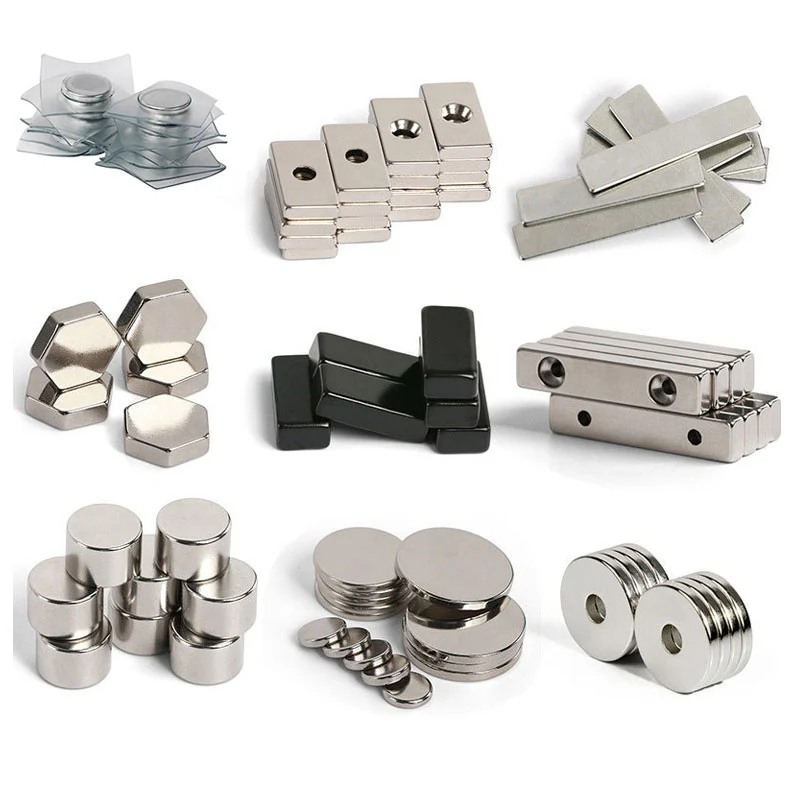
| Magnet Shape | Best Container | Spacer Material | Max Stack Height |
|---|---|---|---|
| Disc / Cylinder (≤ 20 mm dia.) | Anti-static compartment boxes | ESD-safe polyurethane foam | 8 layers |
| Block / Rectangular (30–80 mm) | Wooden crates with vertical dividers | 5 mm cork sheets | 5 layers |
| Ring / Annular | Plastic tubes with central rods | Nylon bushings | 10 tubes per rack |
| Custom Arc / Segment | Dedicated jig with contour pockets | RTV silicone pads | 3 layers (horizontal) |
This layout reduces the risk of magnetic “chain reactions,” where one moving NdFeB magnet triggers a cascade of collisions. Zhao BAO provides free layout consultation for clients storing more than 1,000 units per month.
Emergency Response and Routine Inspection
Even with perfect storage, conduct a monthly visual inspection. Look for: (a) white or green powdery deposits (early corrosion), (b) loose coatings, and (c) any misaligned keepers. If a NdFeB magnet shows signs of rust, isolate it immediately—corrosion particles are abrasive and can contaminate nearby precision instruments. For accidental finger entrapments, never yank the victim’s hand; instead, slide a thin plastic shim between the magnets to release pressure gradually. Keep a non-magnetic stretcher and first-aid kit within 5 meters of every storage rack.
Final Word: Storage Is an Investment, Not an Overhead
Every minute spent organizing your NdFeB magnet inventory saves hours of rework, replacement costs, and workplace injury claims. At Zhao BAO, we view proper storage as the foundation of magnetic assembly quality—our technical team routinely visits customer sites to audit storage practices and recommend tailored solutions, from desiccant packs to full-scale magnet cabinets with interlocks.
Ready to optimize your NdFeB magnet handling workflow?
Contact Zhao BAO today for a free 30-minute storage audit with our senior magnetics engineers. We will deliver a customized risk assessment, sample keeper sets, and a humidity-control checklist—all within 48 hours. Your magnets deserve more than a shelf; they deserve Zhao BAO precision care.