

How Does a Photoelectric Encoder Improve Motion Control Accuracy?
2026-08-24
Article Summary: A Photoelectric Encoder is a precision feedback device that converts rotary motion into electrical signals, allowing a control system to determine shaft position, rotational speed, and direction. In modern automation, the quality of motion feedback directly affects positioning accuracy, synchronization, productivity, and equipment reliability. This article explains how a Photoelectric Encoder works, what components influence its performance, how to select the right model, and how proper integration can solve common motion-control problems. It also examines incremental and absolute technologies, key specifications, industrial applications, installation considerations, and common troubleshooting methods. With practical product knowledge and motion-control experience, SEA MOTION provides encoder solutions designed for demanding automation and precision-motion applications.
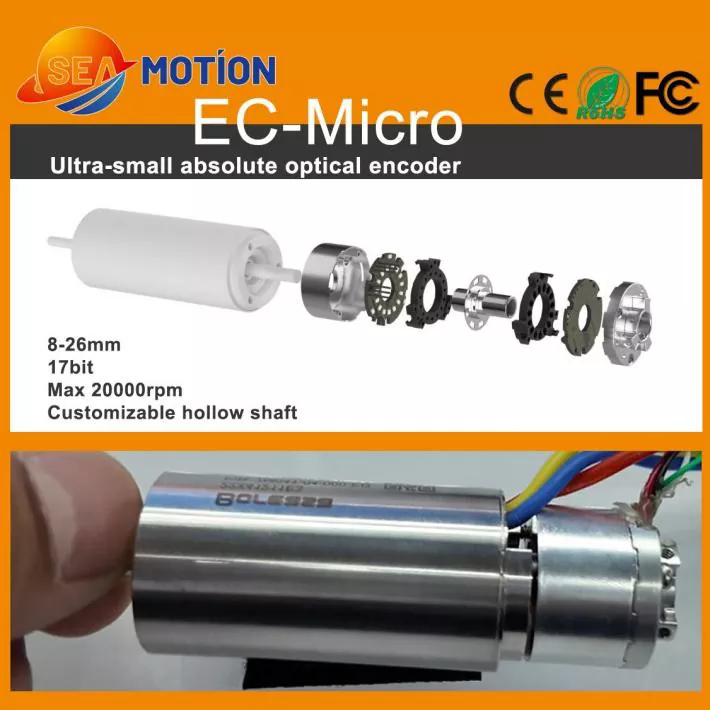
Table of Contents
- 1. Introduction to Photoelectric Encoder Technology
- 2. How Does a Photoelectric Encoder Work?
- 3. How Does a Photoelectric Encoder Improve Motion Accuracy?
- 4. What Are the Main Types of Photoelectric Encoders?
- 5. Which Specifications Matter When Choosing a Photoelectric Encoder?
- 6. Where Are Photoelectric Encoders Used?
- 7. How Can Engineers Select the Right Photoelectric Encoder?
- 8. How Should a Photoelectric Encoder Be Installed?
- 9. How Can Common Photoelectric Encoder Problems Be Prevented?
- 10. Why Consider SEA MOTION for Motion Feedback Solutions?
- 11. Article Outline
- 12. Frequently Asked Questions
- 13. Conclusion
1. Introduction to Photoelectric Encoder Technology
Modern machines are expected to move faster while maintaining increasingly tight positioning tolerances. Whether the application involves a servo motor, robotic joint, CNC axis, packaging mechanism, semiconductor handling system, or automated production line, the controller needs reliable information about what the motor or shaft is actually doing.
This is where a Photoelectric Encoder becomes essential. Rather than allowing the controller to rely only on a motor command, the encoder continuously provides feedback about mechanical movement. The control system can compare the commanded position with the measured position and make corrections when necessary.
A photoelectric design uses optical sensing to detect patterns or interruptions associated with a rotating code disc. The resulting electrical signals are interpreted by a drive, motion controller, PLC, or other electronic control system. Depending on the encoder architecture, the feedback can represent incremental movement or an absolute angular position.
The practical value of this technology is not simply higher measurement resolution. A properly selected encoder can help a machine achieve more consistent positioning, better speed regulation, improved synchronization, smoother servo operation, and greater production stability.
For machine builders, the challenge is choosing an encoder that matches the motor, controller, mechanical structure, environmental conditions, and required accuracy. An encoder with excellent specifications can still perform poorly if its output interface, mechanical mounting, resolution, or environmental protection does not match the application.
2. How Does a Photoelectric Encoder Work?
The operating principle of a Photoelectric Encoder is based on converting mechanical rotation into measurable optical changes and then transforming those changes into electrical signals.
A typical optical encoder contains several important elements:
- Light source: Generates the optical signal used for sensing.
- Code disc: Contains precisely arranged transparent and opaque areas or coded patterns.
- Photodetector: Detects changes in transmitted or reflected light.
- Signal-processing electronics: Convert the detected optical pattern into usable electrical output signals.
- Mechanical shaft and housing: Connect the encoder to the rotating equipment and protect internal components.
When the shaft rotates, the code disc moves relative to the optical sensing system. The changing light pattern produces corresponding electrical signals. The controller analyzes these signals to determine movement.
In an incremental encoder, movement is generally represented through pulses. The controller counts pulses to determine how far the shaft has moved and analyzes pulse frequency to determine speed. Two-channel outputs can also provide directional information.
An absolute encoder works differently. Instead of relying only on pulse counting from a reference point, it provides a coded representation of the shaft's position. This can be particularly valuable in machines that need position information immediately after power restoration.
The complete feedback chain can therefore be understood as:
Mechanical Rotation → Optical Detection → Electrical Signal → Controller Interpretation → Motion Correction
The reliability of every stage matters. Mechanical vibration, electrical noise, incorrect signal levels, poor alignment, or an unsuitable encoder specification can reduce the quality of the final feedback.
3. How Does a Photoelectric Encoder Improve Motion Accuracy?
Motion accuracy depends on more than the motor itself. A servo system needs accurate feedback to determine whether the commanded movement has actually occurred. The Photoelectric Encoder supplies this feedback.
Several performance benefits can result from high-quality feedback.
Precise Position Feedback
The encoder provides position information that the controller can use to identify deviations between the target and actual position. When the machine requires fine angular positioning, higher encoder resolution can provide more detailed feedback.
Better Speed Regulation
Encoder signal frequency provides information about rotational speed. The servo drive can use this information to adjust motor output dynamically. This helps maintain a stable speed when load conditions change.
Improved Direction Detection
Many incremental encoder configurations use multiple output channels with a defined phase relationship. The controller can analyze the phase relationship to determine the direction of shaft rotation.
Closed-Loop Control
Open-loop systems assume that the commanded motion has occurred. Closed-loop systems measure actual motion and respond to errors. This feedback mechanism is particularly important when external loads, friction, inertia, or mechanical disturbances can affect movement.
Better Synchronization
Machines with multiple rotating components often require coordinated movement. Encoder feedback allows the controller to monitor the relationship between axes and adjust commands when synchronization begins to drift.
For example, packaging machinery may need a cutting mechanism to remain synchronized with material movement. Even a small timing error can produce incorrect cutting positions or product waste. Accurate feedback helps the controller maintain the intended relationship between moving components.
4. What Are the Main Types of Photoelectric Encoders?
Choosing between encoder architectures starts with understanding how position information needs to be generated and retained.
| Encoder Type | Feedback Method | Typical Strength | Common Application Consideration |
|---|---|---|---|
| Incremental Photoelectric Encoder | Pulse-based feedback | High-speed motion feedback and straightforward control | Usually requires a reference or homing process for absolute machine position |
| Absolute Single-Turn Photoelectric Encoder | Unique position code within one revolution | Immediate angular position feedback | Useful where accurate single-revolution positioning is important |
| Absolute Multi-Turn Photoelectric Encoder | Position plus multiple-turn information | Tracks angular position across multiple rotations | Suitable for applications requiring extended rotary travel information |
Incremental encoders can be attractive for high-speed applications where pulse-based feedback is sufficient. Absolute encoders become particularly useful when the machine needs to know its position without relying entirely on a startup homing routine.
The correct choice depends on the complete motion architecture rather than the encoder category alone.
5. Which Specifications Matter When Choosing a Photoelectric Encoder?
One of the most common purchasing mistakes is selecting an encoder based only on resolution. Resolution is important, but it is only one part of the specification.
| Specification | Why It Matters |
|---|---|
| Resolution | Determines the level of position detail available to the control system. |
| Output Type | Must be compatible with the controller or servo drive input. |
| Operating Speed | Ensures the encoder can reliably track the required shaft speed. |
| Shaft Diameter | Must match the mechanical connection or coupling arrangement. |
| Radial and Axial Load | Determines whether the encoder can tolerate mechanical forces from the installation. |
| Mounting Configuration | Affects mechanical compatibility and installation space. |
| Protection Rating | Indicates suitability for dust, moisture, and other environmental exposure. |
| Operating Temperature | Ensures reliable operation under the actual machine temperature range. |
| Shock and Vibration Resistance | Important for industrial equipment with mechanical disturbances. |
| Electrical Interface | Determines how the encoder communicates with the control system. |
Engineers should also consider cable length, grounding, electromagnetic interference, connector configuration, allowable installation tolerances, and maintenance requirements.
For safety-related applications, additional functional-safety requirements may apply. The encoder must be evaluated together with the safety architecture rather than treated as an isolated component.
6. Where Are Photoelectric Encoders Used?
Photoelectric Encoder technology is widely used wherever precise rotary feedback is required. Its applications range from general industrial automation to highly specialized precision equipment.
- Robotics: Provides joint or motor feedback for accurate movement and repeatability.
- CNC machinery: Supports accurate axis positioning and spindle-related feedback.
- Packaging machines: Helps coordinate conveyors, sealing systems, cutting mechanisms, and other moving parts.
- Printing equipment: Supports synchronization between rotating cylinders and material movement.
- Semiconductor equipment: Provides high-resolution feedback for precision positioning systems.
- Medical equipment: Supports controlled movement in automated mechanisms and precision positioning assemblies.
- Elevators and escalators: Provides motion feedback for drive and positioning systems.
- Wind-energy equipment: Can support position monitoring and control functions in rotating mechanisms.
- Factory automation: Enables accurate feedback for servo-driven machinery and production systems.
- AGVs and mobile robots: Helps monitor motor rotation and movement-related parameters.
The operating environment varies dramatically between these applications. A clean laboratory machine may place greater emphasis on compact dimensions and resolution, while factory machinery may prioritize vibration resistance, electrical noise immunity, and environmental protection.
7. How Can Engineers Select the Right Photoelectric Encoder?
A systematic selection process reduces compatibility problems and prevents unnecessary replacement costs.
Step 1: Define the Motion Requirement
Determine the required speed, positioning accuracy, travel range, acceleration, deceleration, and duty cycle. These factors establish the basic feedback requirements.
Step 2: Determine Incremental or Absolute Feedback
If the machine can perform a reliable homing routine and primarily needs pulse-based feedback, an incremental encoder may be appropriate. If the machine needs position information immediately after startup or power interruption, an absolute solution may be more suitable.
Step 3: Calculate the Required Resolution
Resolution should be selected according to the actual mechanical accuracy requirement. Extremely high resolution is not automatically beneficial if the mechanical system cannot utilize it. Excessive resolution can also increase controller data-processing and signal-management requirements.
Step 4: Confirm Electrical Compatibility
Check the controller's supported input type, voltage level, frequency capability, connector arrangement, and communication requirements. Signal compatibility should be confirmed before purchasing.
Step 5: Check Mechanical Compatibility
Verify shaft size, mounting dimensions, allowable loads, coupling requirements, available installation space, and shaft alignment. Mechanical mismatch can cause premature bearing wear, unstable feedback, or encoder damage.
Step 6: Evaluate the Environment
Consider dust, water, oil mist, temperature, vibration, shock, electromagnetic interference, and installation location. An encoder intended for a clean environment may not be suitable for heavy industrial machinery.
Step 7: Consider Long-Term Service
For production equipment, availability, technical support, replacement compatibility, documentation, and customization capability can be as important as the initial purchase price.
8. How Should a Photoelectric Encoder Be Installed?
Even a high-performance encoder can produce unstable feedback when installation is poorly executed. Mechanical and electrical installation should therefore be treated as part of the encoder selection process.
- Maintain proper shaft alignment.
- Use a suitable coupling where required.
- Do not exceed specified radial or axial loads.
- Avoid forcing the encoder shaft into an incompatible mechanical connection.
- Keep signal cables separated from high-power cables when practical.
- Use appropriate shielding and grounding practices.
- Protect connectors from moisture, oil, and mechanical impact.
- Verify the output signal format before connecting the encoder to the controller.
- Check signal quality during commissioning.
- Confirm the actual direction of feedback before placing the machine into automatic operation.
Good installation practices reduce false pulses, communication errors, mechanical stress, and unexpected position deviations.
9. How Can Common Photoelectric Encoder Problems Be Prevented?
Encoder-related failures are not always caused by the encoder itself. Problems may originate from mechanical installation, electrical interference, incorrect parameter settings, or unsuitable operating conditions.
| Problem | Possible Cause | Practical Prevention |
|---|---|---|
| Position drift | Mechanical backlash, coupling slip, or incorrect feedback configuration | Inspect the mechanical transmission and verify controller parameters. |
| Intermittent pulses | Electrical interference, loose wiring, or connector problems | Check shielding, grounding, connectors, and cable routing. |
| Incorrect direction | Incorrect channel configuration or wiring | Verify phase relationships and controller settings. |
| Feedback loss at high speed | Encoder or controller frequency limitation | Confirm maximum operating speed and input frequency requirements. |
| Premature mechanical failure | Excessive shaft load or misalignment | Check installation tolerances and coupling alignment. |
| Startup position error | Inappropriate encoder type or reference strategy | Consider an absolute encoder when immediate position feedback is required. |
When troubleshooting, engineers should avoid replacing the encoder immediately. First inspect the complete feedback chain: mechanical connection, wiring, power supply, signal interface, controller parameters, and environmental conditions.
10. Why Consider SEA MOTION for Motion Feedback Solutions?
SEA MOTION focuses on motion-control components and encoder technologies for demanding automation applications. Its product portfolio includes photoelectric encoder solutions as well as other feedback and motion-control products.
The company's Photoelectric Encoder offerings are positioned for applications where compact construction, accurate feedback, compatibility, and reliable motion control are important. Its product range includes incremental and absolute photoelectric encoder solutions, including single-turn and multi-turn configurations for different machine architectures.
SEA MOTION also supports a broad range of industrial applications, from automation and robotics to precision manufacturing and specialized motion systems. This application-oriented approach is important because an encoder should not be selected solely from a catalog specification.
For OEMs and system integrators, the most useful supplier is one that can help connect the encoder specification with the actual machine requirement. Important considerations include resolution, output interface, mechanical dimensions, environmental conditions, operating speed, and system compatibility.
When evaluating an encoder supplier, buyers should ask practical questions such as:
- Can the encoder be matched to the existing servo drive?
- Are suitable mechanical configurations available?
- Can the required resolution and speed be supported?
- Is the encoder suitable for the machine's operating environment?
- Are technical specifications and installation information available?
- Can customized requirements be discussed for OEM projects?
- Is technical support available when commissioning or troubleshooting the system?
These questions help shift the purchasing decision from simply comparing prices to evaluating total application suitability.
11. Article Outline
- Technology Introduction: Explains the role of Photoelectric Encoder feedback in modern motion control.
- Working Principle: Describes how optical detection converts shaft rotation into electrical feedback.
- Accuracy Benefits: Explains how feedback supports positioning, speed control, direction detection, and synchronization.
- Encoder Types: Compares incremental, absolute single-turn, and absolute multi-turn configurations.
- Key Specifications: Covers resolution, output, speed, mechanical dimensions, environmental protection, and electrical compatibility.
- Industrial Applications: Reviews robotics, CNC equipment, packaging, printing, semiconductor machinery, medical equipment, and other applications.
- Selection Process: Provides a practical framework for choosing an encoder according to machine requirements.
- Installation: Identifies mechanical and electrical practices that support reliable operation.
- Troubleshooting: Addresses common feedback problems and their potential causes.
- SEA MOTION: Introduces the company's motion-control and encoder capabilities.
- FAQ: Answers common questions from engineers, OEMs, and purchasing teams.
12. Frequently Asked Questions
What is a Photoelectric Encoder?
A Photoelectric Encoder is an optical feedback device that converts rotary mechanical movement into electrical signals. A controller can use these signals to determine position, speed, and direction.
What is the difference between an incremental and absolute Photoelectric Encoder?
An incremental encoder typically generates pulses corresponding to movement, while an absolute encoder provides coded position information. Incremental systems often use a homing or reference procedure, whereas absolute systems can provide direct position information according to their architecture.
Does higher encoder resolution always mean better machine accuracy?
No. Higher resolution provides more detailed feedback, but overall machine accuracy also depends on mechanical stiffness, backlash, transmission accuracy, controller performance, installation quality, and other system-level factors.
Can a Photoelectric Encoder measure speed?
Yes. The controller can determine rotational speed from the frequency of encoder feedback signals. The exact measurement method depends on the encoder type and control architecture.
Why does encoder output compatibility matter?
The encoder's electrical output must be compatible with the receiving controller or drive. An incompatible voltage level, signal format, frequency capability, or communication interface can prevent reliable feedback even when the encoder's mechanical specifications are correct.
Can Photoelectric Encoders be used in robotics?
Yes. They are widely applicable to robotic motion systems because accurate feedback is essential for controlling motor position, speed, and movement. The specific encoder should be selected according to joint speed, resolution, mechanical dimensions, environmental conditions, and control architecture.
What should be checked when an encoder produces unstable signals?
Inspect the power supply, signal cables, connectors, grounding, shielding, cable routing, mechanical coupling, shaft alignment, controller parameters, and operating speed. Electrical interference and mechanical installation problems can both produce unstable feedback.
How can engineers choose a suitable Photoelectric Encoder supplier?
Look beyond the product price. Evaluate technical specifications, application experience, product compatibility, customization capability, quality control, documentation, delivery capability, and after-sales technical support. A supplier that understands the complete motion-control application can reduce integration risk.
13. Conclusion
A Photoelectric Encoder plays a fundamental role in modern closed-loop motion control by converting mechanical rotation into precise electrical feedback. It allows controllers to understand actual shaft movement rather than relying solely on commanded motion.
The right encoder can contribute to accurate positioning, stable speed regulation, reliable direction detection, coordinated multi-axis movement, and improved machine performance. However, successful implementation depends on choosing the correct resolution, encoder architecture, output interface, mechanical configuration, environmental rating, and operating range.
For OEMs, automation engineers, system integrators, and industrial equipment manufacturers, the most effective approach is to evaluate the encoder as part of the complete motion-control system. Mechanical transmission, servo drive, controller, cabling, environmental conditions, and feedback requirements should all be considered together.
SEA MOTION provides Photoelectric Encoder and motion-control solutions for a variety of precision automation applications. If you are looking for a suitable encoder for a new machine, replacing an existing feedback component, or developing a customized motion-control system, contact us to discuss your application requirements and find a suitable solution.