

How Do You Calculate the Holding Force for Short-Type Vacuum Suction Cups ZP2-MU in Vertical Applications
2026-08-31
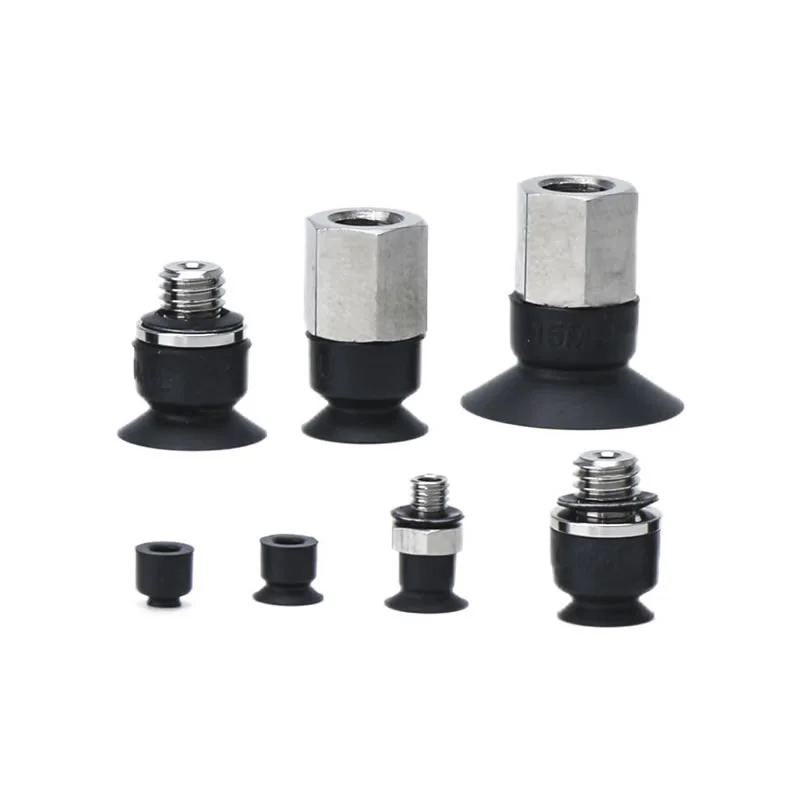
When automating pick-and-place operations, engineers often struggle with a fundamental question: will the Short-type Vacuum Suction Cups ZP2-MU hold the workpiece securely when lifted vertically? Unlike horizontal applications where gravity works with the cup, vertical lifting introduces shear forces and peeling risks that demand precise calculations. For manufacturers like Comma, getting this math right separates reliable automation from repeated drop incidents.
The Core Formula for Vertical Holding Force
The holding force for Short-type Vacuum Suction Cups ZP2-MU in vertical orientation depends on three variables: effective suction area, vacuum level, and the coefficient of friction between the cup lip and the workpiece surface.
Basic equation:
F_h = (P_v × A_e × μ) / S
Where:
-
F_h = Required holding force (N)
-
P_v = Vacuum pressure (kPa, negative gauge)
-
A_e = Effective suction area (cm²)
-
μ = Friction coefficient (material pairing)
-
S = Safety factor (typically 2–4 for vertical)
Step-by-Step Calculation Example
Assume you are using a Short-type Vacuum Suction Cups ZP2-MU with a 10 mm diameter nipple, pulling -60 kPa vacuum on a smooth steel plate.
| Parameter | Value | Unit |
|---|---|---|
| Cup diameter (d) | 10 | mm |
| Effective area (A_e) | 0.785 | cm² |
| Vacuum level (P_v) | -60 | kPa |
| Friction coefficient (μ) – steel/rubber | 0.6 | dimensionless |
| Safety factor (S) – vertical dynamic | 3.0 | dimensionless |
Calculation:
F_h = (60 × 0.785 × 0.6) / 3.0 = 9.42 N
That means one Short-type Vacuum Suction Cups ZP2-MU can securely hold about 0.96 kg vertically under these conditions. For heavier loads, Comma recommends either increasing vacuum level, using multiple cups, or selecting a larger cup size.
Critical Factors That Alter the Result
| Factor | Impact on Holding Force | Recommendation from Comma |
|---|---|---|
| Surface roughness | Reduces μ by 20–50% | Use soft NBR or silicone lips |
| Acceleration/deceleration | Increases dynamic load | Add 1.5× multiplier for high-speed |
| Cup wear (age) | Decreases A_e effectively | Replace every 500k cycles |
| Temperature > 60°C | Lowers rubber stiffness | Switch to FKM material option |
Pro tip: The Short-type Vacuum Suction Cups ZP2-MU from Comma feature a specially designed lip geometry that maintains μ even on slightly oily surfaces—a common pain point in stamping press feeding lines.
Common Mistakes in Vertical Holding Calculations
-
Using theoretical area instead of effective area – the inner ribbing of Short-type Vacuum Suction Cups ZP2-MU reduces A_e by about 8–12%.
-
Ignoring peel-off torque – when the robot arm rotates, the cup experiences a peeling moment; always multiply F_h by 1.3 for rotational axes.
-
Forgetting the safety factor – vertical applications are unforgiving. Comma engineers advise S ≥ 3.0 for unmanned cells.
FAQ – Short-type Vacuum Suction Cups ZP2-MU Common Questions
Q: Can I use the same holding force formula for porous materials like cardboard or wood?
A: No. For porous surfaces, the effective vacuum pressure (P_v) drops significantly because air flows through the material. You must measure the "leakage rate" and reduce P_v by 30–50% in your calculation. For example, if your gauge reads -60 kPa on a sealed surface, you may only get -35 kPa on corrugated cardboard. Comma offers a dedicated porous-media version of the Short-type Vacuum Suction Cups ZP2-MU with built-in flow restrictors to compensate for this loss.
Q: How does the cup’s short-type design affect holding force compared to a standard-depth cup?
A: The short-type profile reduces the effective suction volume, which actually improves response time, but it also slightly reduces the flexible deformation that helps conform to uneven surfaces. For vertical applications on flat or mildly curved parts, the Short-type Vacuum Suction Cups ZP2-MU delivers 92–95% of the holding force of a deeper cup with the same diameter—while being 40% more compact. This makes it ideal for tight tooling spaces where standard cups simply won't fit. Comma’s lab tests confirm that the short lip design maintains stable μ across a wider tilt angle range (±5°).
Q: What is the maximum safe vertical load for a single Short-type Vacuum Suction Cups ZP2-MU at -80 kPa?
A: At -80 kPa vacuum, with a clean, dry steel surface (μ = 0.7) and a safety factor of 3.0, the maximum safe vertical load is approximately 1.46 kg for the 10 mm diameter version. However, if you use the 16 mm diameter variant, that number jumps to 3.75 kg. Always check the datasheet from Comma, as the exact value depends on the lip compound (NBR, silicone, or FKM) and operating temperature. For critical lifts, Comma strongly recommends a dual-cup configuration to provide redundancy—even if one cup loses vacuum, the other can momentarily hold the load until emergency stops engage.
Best Practices from Comma Engineering Team
-
Always test your calculated force with a "dead-weight" trial at 120% of the theoretical value.
-
For vertical applications with high acceleration (> 2 G), increase safety factor to 4.0.
-
Use a vacuum switch with a pressure sensor to monitor real-time holding force.
-
Clean cup lips weekly—oil and dust reduce μ by up to 40%.
Final Checklist Before Deployment
| Item | Status |
|---|---|
| Effective area calculated (not nominal) | ☐ |
| Friction coefficient verified with actual material | ☐ |
| Safety factor ≥ 3.0 applied | ☐ |
| Dynamic loads (acceleration) included | ☐ |
| Cup material compatible with workpiece (temperature/chemicals) | ☐ |
| Redundancy plan (multiple cups or backup vacuum) | ☐ |
Need a Custom Holding Force Calculation for Your Line?
Every vertical application has unique variables—part geometry, surface finish, cycle speed, and environmental conditions. The Short-type Vacuum Suction Cups ZP2-MU from Comma are engineered to deliver consistent performance, but we know that one formula doesn't fit all.
Contact us today with your workpiece specifications and motion profile. Our application engineers will run a detailed holding force simulation, provide a tailored selection matrix, and even send you sample cups for on-site testing. Don't guess your vertical lift—let Comma calculate it with precision. Reach out via our website or call your regional distributor—we respond within 4 business hours.